Pokazywanie postów oznaczonych etykietą material. Pokaż wszystkie posty

sobota, 10 marca 2012

1 Mould = X vases

A plaster mould is created from a hand turned vase. The life of a common plaster mould allows for use of up to 70 times. This project is based on the reproduction of a mould until it is worn out. The vase would be replicated as many times as the mould would allow.
The extraction of the vase from the mould would be done without any sort of retouching, making the mould
’s wear visible in the final result/apparatu

sobota, 25 lutego 2012

The Slab Vases

The Slab Vases consist of rings of Silestone, which have been slipped over a metal bracket to create a sculptural vase. The rings vary in size and are cut so the shape of the vase changes with each assembly. The material is of Iberian origin, but Scandinavian sensibilities run through the Slab Vases project. The material comes in a wide range of colours. Form Us With Love has worked with different shades of grey as well as tones of hot red and orange/form us with love


piątek, 24 lutego 2012

Hoof table

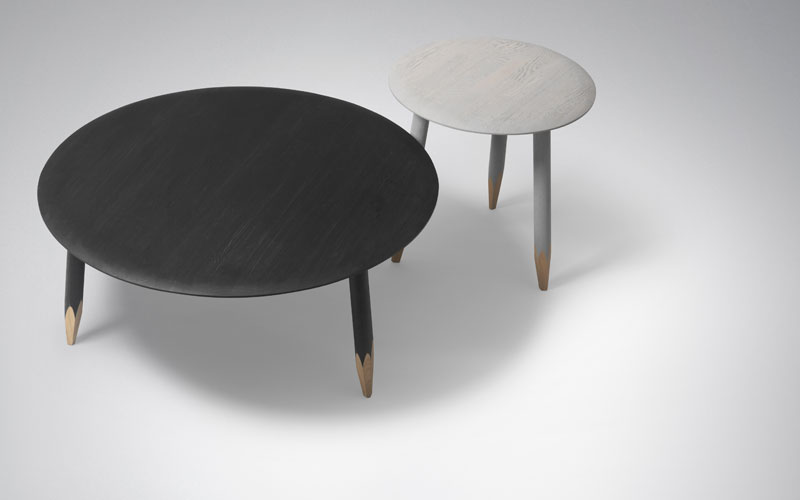
The main inspiration for the Hoof tables starts from the foot detail. I have always loved the painted wooden chairs that have the end of the legs left as natural wood so that the paint doesn’t chip off if kicked or knocked. The leg ends of the table are sharpened at the foot – like a horse’s hoof is trimmed before it is shod. This detail has derived from continuous exploration and development of production techniques. The fine edge of the tables is created from the soft chamfer being on the top and bottom. This also gives the tables a tactile feel and clearly shows that the tables are made from solid wood. The foot detail is created by reversing the usual production process; most furniture details, which have a painted section and a natural part, are assembled, masked off, and then painted. Hoof is painted first, then cut back to produce the unique detail/Samuel Wilkinson

vasels

These vasels, masks and sculptures utilize an old crafting technique in which rope or cord is coiled and stitched to forms bowls and baskets. The technique is itself based on the ancient method of making ceramic coiled pots as well as coiled basketry. The method explores ways of transforming a linear material into three-dimensional objects, an interest I have also studied in other materials such as yarn or plastic tubing. I also see the process as a form of analog 3D printing/prototyping performed by a sewing machine and with much less precision. In this way the "3D file" is in my head as I begin each piece and its formation happens by making certain adjustments to the work while sewing. The process has its own limitations, largely determined by the sewing machine, and each piece takes on deformations and glitches that give it unique personality.
The studies use the raw 100% cotton braided cord, often called sash cord, and colored sewing thread. They are individually sewn on an industrial zig-zag sewing machine without the use of forms or molds and allow me to explore ideas for larger works such as Rumpleskillskid/Doug Johnston


piątek, 7 października 2011

Bol

Bol is a side table but also a bowl, where things can be placed and stored. It consists of a pressed metal shell, hold on three points and a frame made of ash wood. The frame can be easily taken apart and packed/Sarah Boettger


poniedziałek, 13 czerwca 2011

niedziela, 22 maja 2011

cordbags

This series is inspired by the artistic concept of packaging of products, buildings and trees, like it exists in art (Christo). This series has three bags of Tyvek, a material that looks a bit like paper but isn't. The visual aspect of packaging is central in this series/Ilvy Jacobs

niedziela, 15 maja 2011

Piao 飘 -Paper Chair

Gluing layers of paper is the way how to make a traditional paper umbrella. Our Paper Seat is using the same craft. The paper layers are combined until the chair is strong enough to sit on, but is still keeping its flexibility. Hand made paper is rich of natural fibers that give strength to carry a person and is therefore our choice for this comfortable chair/innovo design

Accordion Cabinet

Somehow there is movement in this creation; even without the operation of opening and closing the doors. The rhythmic series of wood textile undulating in and out, the play of shadows and the varying light and dark wood tones create a melody as the object stands alone. It is these eye catching features that draw one into the object and spark your interest to interact with the cabinet. Opening the doors and watching the fabric stretch and fold; the beauty of natural wood that has become something flexible, it is all an experience that keeps you intrigued and interested. It creates a moment, as the designers had intended, that is an emotional connection. The goal was to create this unique furniture piece with character that promotes a longer lasting relationship between the object and user/Elisa Strozyk and Sebastian Neeb


wardrobe bench

The WARDROBE BENCH is the the perfect assistant for tying your shoes. Both “storeys” of the bench are waterjet cuted out of one linoleum covered laminated wood panel. At the one hand the “lower storey” stabilizes the construction and on the other hand it offers a comfortable platform for tying shoes. The bench can be disassembled and shipped very flat packed/Paul Evermann

Di Corte

Di Corte, designed by Andrea Magnani, Giovanni Delvecchio and Elisabetta Amatori of Resign, is a series of chairs that look as though they’re going back to their roots

sobota, 2 kwietnia 2011

tight stool

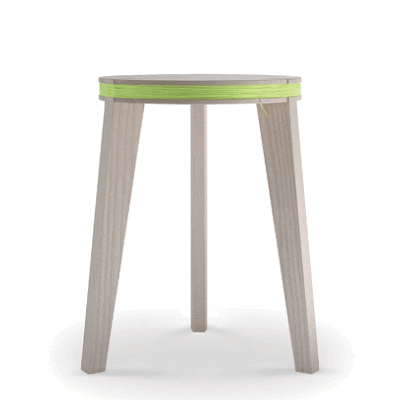
Tight stool is a wooden puzzle of legs and seat kept together with a coloured thread. This stool is inspired by the elementary binding system people use in everyday life to place together loose elements and form, change or fix objects. The thread is essential to the construction of the stool, it's the structural binding element, but it indirectly brings a decorative note that refers to the tradition of trimming. With a simple element as a rope, individual elements stick together to make a seat/Diane Steverlynck

czwartek, 3 lutego 2011

3mm

Beginning of this project was the fascination of the fantastic shapes that can be achieved by folding a single piece of paper. We are constantly working with models and paper templates in our work process, and we were interested in the relation between the defined forms and the thin material. Therefore parallel to our shape studies a process occurred with material research in order to find the right material to forward these shapes and to perform a chair with this paperthin and simple expression.
It has been a long and complex process, and prior to the final prototype we have realized a wide range of models in 1:1 both in thermoforming, veneer and iron. The final result is made of a 3 mm aluminum sheet, thereas the name 3 mm chair, and this ultrathin aluminum shell, is placed on a cantilever structure, which makes the shell float in the back. The structure is more robust than the shell, which creates a strong contrast that makes the shell seem even lighter, and look just like a sheet of folded paper/Gam Fratesi

 
Web Statistics