Small table is defined by two distinct silhouettes, a circular top with 3 legs and a square top with four legs. Both forms echo the taut aesthetic and angled stance, counterbalanced by the detailed richness of solid timber that is a hallmark of the Toro collection/Ivan Woods for Schiavello
Wood and metal low table. As the name suggest, inspiration comes from Prouvé’s Gueridon table, famous for simplicity of construction and material reduction. These guidelines led to this low table, in which three plywood legs are joined and separated by three metal lobes. It’s a lightweight object, easily packaged and shipped, with a low-impact on environment and formally simple/Giorgio Biscaro
Bedside/table lamp using the same aesthetic of well-known director’s chair (hence the name, meaning “Light, Action!”. It’s a LED lamp that when “closed” is off, but get swtiched on when is spread and cn be placed on the table or the bedside cabinet. Inspiration comes from seeing that a bedside lamp occupies the same volume wether it’s on or off, while Luceazione is a lightweight presence when not used, similar to a book’s one/Giorgio Biscaro
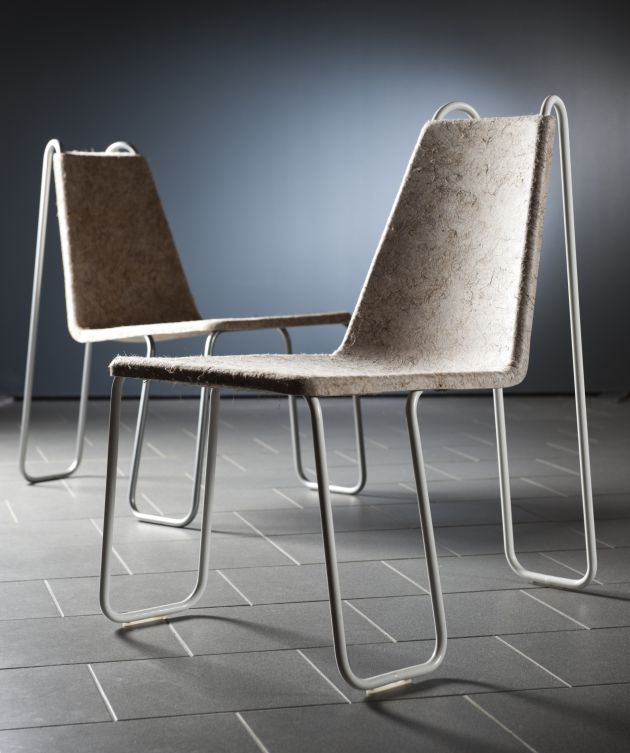
Timo Hoisko has created the Farmline chair out of a single metal tube and locally-produced hemp fiber. I believe in sustainable development, and in the design our products we should promote nature-conserving renewable materials. I wanted to design an ecological chair using locally-produced hemp fiber, a rare material in the furniture industry that I believe would create new opportunities in furniture design.Hemp fiber is an ecological material, as it is cultivated and processed locally at a near-by farm. This is carried in the name itself: ”Farmline”. Hemp fiber can be recycled thanks to its adhesive (PET), enabling us to reuse it for good instead of throwing it away: thus its life cycle does not end in the litter box, as all of its materials can be recycled and then re-introduced in production.
Cloud Stool is inspired by the flexibility and softness of the cloudscape. It can be singular or become a group as a human being. It gives the illusion that it’s alive, by using irregularity, flexibility and subtle differences in tone of perception. Conclusively, the form interacts between objects, and people could explore with it/joon & jung
Tuukka Halonen has designed a range of pendant lights made of repeated interlocking parts. Called Pilke, the light shades are made of identical plywood cutouts, which interlock to form a three-dimensional shape
Besetzer was born of the project "Berlin, the Character of a City as a Design Principle".Formally the sofa is analogous to the idea of a city as a conglomerate of buildings. The upholstered blocks can be arranged in a wide variety of ways and are reminiscent of the pre-fab Plattenbauten blocks of East Berlin or their Western equivalents in districts such as the Hansaviertel. Each block is a different size and made of a different material using different techniques. This heterogeneity reflects the many faces of the city, the differences between and the individuality of each of the various districts. A slotted metal frame allows the blocks to be moved around over rails on the ground. These rails are what link the various elements of the piece into a whole, but the blocks are not dependent on them and can easily be moved beyond the confines of the grid/valerie otte
Neolastic is based on the principles of experimental archeology. The production techniques are primitive. The objects are all handmade by pouring liquid polymer over a mould made of sand. The objects present focus on simplicity and confront our views of modern civilization/Sjoerd Jonkers
Offset stool is obtained through the repetition of some plywood strips bent at the same angle, manufactured by the producer by bending a long, single sheet of plywood and then cutting it into pieces. These pieces are drilled and paired to three pantograph cut legs through three couples of little iron bars to avoid glueing and provide extra stiffness. At this stage, the stool is a compact body, but its resulting shape is still quite uneven, because all the bent stripes are the same length, and this make the seat kinda “rough”. To obtain a smooth profile, the stool is milled with the help of a guide and no other processes are needed/Giorgio Biscaro/via:dezeen