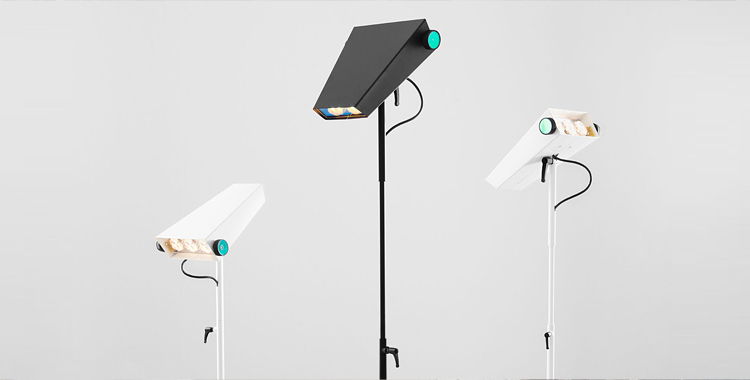
I yearn for a nomadic life, traversing a continent and crisscrossing meadows. With setting a fire and pitching a simple tent, there will be soon their home. I try imitating them in my dark house. Rong's wire is long enough to make me a nomad within the house. From living room to bedroom, bedroom to kitchen, kitchen to... There is no place it cannot reach. Everywhere in the house becomes my own space/Seung Yong Song
Designed by London-based designersGoodwin + Goodwin, the Plus side table is a continuation of their Plus Desk. It was designed so that it could be assembled in moments without the need for any tools or fixings. The affordable table is made in the UK and comes neatly flat-packed in a small box with the legs sitting inside the top
These vasels, masks and sculptures utilize an old crafting technique in which rope or cord is coiled and stitched to forms bowls and baskets. The technique is itself based on the ancient method of making ceramic coiled pots as well as coiled basketry. The method explores ways of transforming a linear material into three-dimensional objects, an interest I have also studied in other materials such as yarn or plastic tubing. I also see the process as a form of analog 3D printing/prototyping performed by a sewing machine and with much less precision. In this way the "3D file" is in my head as I begin each piece and its formation happens by making certain adjustments to the work while sewing. The process has its own limitations, largely determined by the sewing machine, and each piece takes on deformations and glitches that give it unique personality. The studies use the raw 100% cotton braided cord, often called sash cord, and colored sewing thread. They are individually sewn on an industrial zig-zag sewing machine without the use of forms or molds and allow me to explore ideas for larger works such asRumpleskillskid/Doug Johnston
TOR is a side table that does not need a fixed location, it is designed to be moved around. The legs extend through the tabletop creating the grip and giving the table its playful and charming character. The raised rim of the surface prevents objects from falling off. TOR is made of powder coated aluminum and can be ordered in six different colors: intense black, signall white, signall grey, reseda green, pastel turquoise and violet pastel/Ralf Lambie and Johan van Hengel
Remember being a child and having the freedom to imagine life in outer space? To play pretend games with robots and other planets? To escape into a world unknown?As adults, outer space is just as fun to dream about. It is from a childhood fascination with life in the stars and robotic fantasies that Jangir Maddadi first proposed The Droid Lamp/Jangir Maddadi
Bol is a side table but also a bowl, where things can be placed and stored. It consists of a pressed metal shell, hold on three points and a frame made of ash wood. The frame can be easily taken apart and packed/Sarah Boettger
One divided by eight equals six - Not a matter of arithmetic but of eight different places cuts! Inspired by the manufacturing process of glass, all vessels derive from the same basic shape. Using a flexible ring and fitted plastic lids it is possible to combine and close them/ Sarah Boettger
‘Collective works’ is a production process which is just fully functioning when people pay attention to the producing machine. Reacting to its audience, the process translates the flow of people into an object. The resulting outcome varies in colour and size just like the level of interest is varying during the time of production.As soon as one person is coming close and looks at the machine, the production process is started: A wooden 24mm wide veneer-strip is pulled through a glue basin and slowly coiled up around a 20mm thick wooden base. Since the turning platform with the base moves downwards the veneer strip slowly builds up a basket. Once a second person joins to look at the process, a light tone colour is added via a marker onto the veneer. The more people come to look at the machine, the more markers are activated, each with a gradient darker tone. This goes up to four markers, at the same time, staining the veneer-strip black.The interaction is possible due to sensors in the frame of the machine which detect the audience.Depending on the overall interaction time the baskets' height is defined. The more often somebody stops by to watch the process the higher the outcome gets.The machine directly reacts to each observer and thus the outcome is as well directly depending on the audience. Every spectator leaves a mark on the object and therefore each basket becomes an unique record of the people's interest in the object's production. A basket – a vessel used to collect something becomes a collection of data by itself. If nobody is interested in the project, it stops producing at all and the final object just does not get made. This can be seen as 'production on interest'.'Collective works' also questions the relation between man and machine. The audience is turned into workers even tough their effort is basically just their time they spend with the machine - but time is what most of us lack. Somehow. Normally many machines in factories just need some technician to monitor the production and suddenly one machine needs some audience to produce colourful, vivid outcomes/Mischer Traxler